
 EU
EU
 UK
UK
 US
US
 CA
CA

For hunters, campers, and backcountry riders, getting equipment into remote areas can be one of the most demanding parts of an outdoor trip. A folding fat-tire electric bike can make that journey more manageable by combining electric assistance, off-road traction, and a frame that takes up less space during transport.
However, no e-bike is suitable for every trail or hunting area. Tire grip, battery range, motor performance, local regulations, rider skill, weather, and cargo weight all affect the real-world experience. This updated 2026 guide looks at the practical advantages of folding fat-tire e-bikes while also explaining their limitations.
What Is a Folding Fat-Tire Electric Bike?
A folding fat-tire electric bike combines three main features:
- A frame that folds or partially collapses for transportation and storage
- Wide tires designed to provide additional traction and stability on loose surfaces
- An electric motor that assists the rider while pedalling, and on some models, through a throttle
Compared with a conventional mountain bike, a folding fat-tire e-bike is generally heavier but can offer more assistance on hills and while carrying equipment. Compared with an ATV or truck, it is smaller, quieter, and easier to transport, although it cannot carry the same amount of cargo or travel safely across every type of terrain.
For hunters who drive to a trailhead, campsite, cabin, or private property, the folding design can make it easier to fit the bike into an SUV, pickup bed, RV, or other vehicle alongside outdoor gear.
10 Benefits of a Folding Fat-Tire Electric Bike for Hunting
1. Improved Traction on Loose and Uneven Surfaces
Hunting routes can include gravel roads, packed dirt, grass, shallow snow, sand, mud, roots, and other uneven surfaces. Wider tires create a larger contact patch with the ground, which can improve traction and stability compared with narrow bicycle tires.
Tire pressure can also be adjusted for different conditions. Slightly lower pressure may improve grip and comfort on loose surfaces, while higher pressure may reduce rolling resistance on harder roads.
Fat tires do not make a bike capable of crossing every surface safely. Deep mud, ice, steep side slopes, hidden obstacles, and water crossings can still cause a loss of control. Riders should slow down, inspect unfamiliar routes, and avoid damaging wet or sensitive trails.
2. Quieter Access Than Gas-Powered Vehicles
An electric bike is normally much quieter than a truck, motorcycle, ATV, or other gas-powered vehicle. This can help reduce noise around campsites, rural properties, and outdoor recreation areas.
An e-bike is not completely silent. The tires, chain, gears, brakes, suspension, and electric motor all produce some sound. Riders should also avoid assuming that a quiet vehicle makes them undetectable to wildlife.
The practical benefit is reduced operating noise, not silent movement.
3. More Efficient Travel Over Longer Distances
Electric assistance can help hunters cover access roads and trails while using less physical energy than they would on an unassisted bicycle. This can be especially useful when travelling uphill, riding into a headwind, or carrying equipment.
Manufacturers typically publish maximum range estimates measured under favourable conditions. Real-world range can be significantly lower because of:
- Rider and cargo weight
- Cold temperatures
- Soft ground or low tire pressure
- Frequent hills
- High pedal-assist settings
- Throttle use
- Wind and riding speed
Plan the return trip using a conservative range estimate rather than relying only on the advertised maximum.
4. Adjustable Assistance for Hills and Heavy Loads
Multiple pedal-assist levels allow the rider to choose how much support the motor provides. A low setting can conserve battery on easier sections, while a higher setting can help on hills, loose ground, or when transporting additional equipment.
This flexibility can make a folding hunting e-bike more practical than a single-speed motor system. Riders can still pedal normally when conditions allow and increase assistance when the route becomes more demanding.
Motor power does not replace proper riding technique. Selecting the correct bicycle gear, maintaining steady momentum, and controlling wheel spin remain important on steep or slippery terrain.
5. Easier Transportation and Storage
The folding frame is one of the biggest advantages for hunters who already carry boots, clothing, coolers, camping equipment, and other outdoor gear in their vehicle.
Once folded, the bike may fit more easily into:
- An SUV or crossover cargo area
- A pickup bed with other equipment
- An RV storage compartment
- A garage, shed, cabin, or apartment
Always measure the available cargo space and compare it with the bike’s folded dimensions before purchasing. Folding reduces the amount of space a bike occupies, but it does not necessarily make the bike light.
6. Reduced Rider Fatigue
Electric assistance can reduce the effort required to reach a campsite, blind, cabin, or staging area. Conserving energy during the approach may leave the rider feeling more prepared for hiking, setting up equipment, or completing other outdoor tasks.
Full suspension and wide tires may also reduce the amount of vibration transferred to the rider on rough roads. This can improve comfort during longer rides, although saddle fit, riding position, tire pressure, and suspension setup are equally important.
7. More Comfort and Control on Rough Routes
Many all-terrain folding e-bikes include front suspension, rear suspension, or both. Suspension helps the wheels follow uneven ground and reduces the impact of smaller bumps, roots, and potholes.
For hunting and backcountry use, braking performance is just as important as motor power. The additional weight of the battery, motor, rider, and equipment increases stopping distance, especially on wet or steep descents.
Before each ride, inspect the brakes, tire pressure, folding latch, wheel fasteners, chain, battery mount, and lights.
8. Flexible Cargo Options
A folding fat-tire e-bike can be equipped with accessories such as a rear rack, basket, panniers, frame bag, or trailer, depending on the bike’s compatibility and local rules.
These accessories can help organize items such as:
- Rain gear and extra clothing
- Food and water
- Navigation and communication equipment
- Basic tools and tire-repair supplies
- Camping or field equipment
Keep the load balanced and secure. Do not exceed the bike, rack, or trailer manufacturer’s published weight limits. A high or uneven load can make steering and braking less predictable.
9. No Tailpipe Exhaust During Operation
Unlike a gas-powered ATV or truck, an electric bicycle does not produce tailpipe exhaust while it is being ridden. It also generally creates less operating noise and does not require gasoline for each trip.
This does not mean an e-bike has no environmental impact. Batteries, electricity generation, manufacturing, tires, lubricants, and replacement parts all have an environmental footprint. Riders should extend the life of the bike through proper maintenance and recycle batteries through an approved program when they reach the end of their service life.
10. Useful for Camping and Everyday Outdoor Trips
A hunting e-bike does not need to be limited to hunting season. A folding fat-tire model can also be used for camping, fishing access, rural property maintenance, RV travel, trail exploration, and other outdoor trips where its use is permitted.
The folding design is particularly useful for riders who have limited storage space or regularly transport the bike between different locations.
What to Look for in a Hunting E-Bike in 2026
Rather than choosing a model based only on maximum motor power or speed, consider the complete riding system.
Battery Capacity and Real-World Range
Look at the battery’s voltage and amp-hour rating, but remember that terrain, weather, load, and assist level determine the actual riding distance. Cold Canadian weather can noticeably reduce available battery range.
For remote trips, begin with a fully charged battery, plan a return route, and avoid using maximum assistance unnecessarily.
Brakes
Mechanical disc brakes can be straightforward to service, while hydraulic disc brakes generally require less hand effort and may offer more progressive braking control. Whichever system the bike uses, brake condition is critical when descending with cargo.
Suspension
Full suspension can improve comfort and traction on rough ground, but it adds weight and additional maintenance points. Riders who mainly use gravel roads or smoother access routes may not need the same suspension system as someone riding rocky or deeply rutted trails.
Bike Weight and Folded Dimensions
Folding e-bikes are often heavy because they include a motor, battery, reinforced frame, wide tires, and suspension components. Confirm that you can safely lift the bike into your vehicle, or use a ramp and a second person when necessary.
Payload and Accessory Compatibility
The bike’s payload rating normally includes the rider and everything carried on the bike. Check whether the model supports the rack, basket, panniers, or trailer you plan to use.
Replacement Parts and Support
Before buying, review the availability of replacement brake pads, tires, tubes, batteries, chargers, displays, controllers, and other model-specific components.
Are Electric Bikes Legal for Hunting in Canada?
Electric-bike rules in Canada vary by province, territory, municipality, park, trail system, Crown land area, and private property owner. Hunting regulations and motor-vehicle access restrictions may also apply separately.
Before riding, verify:
- Provincial or territorial e-bike classifications
- Municipal road and pathway bylaws
- Park and trail access rules
- Crown land or wildlife management area restrictions
- Private landowner permission
- Current hunting and motor-vehicle regulations
A high-powered or throttle-equipped e-bike may be classified differently from a pedal-assist bicycle. Never assume that a route open to conventional bicycles is automatically open to every type of e-bike.
Observe posted closures, remain on approved routes, yield to other trail users, and avoid riding through wet areas where tires could damage the trail.
Which Jasion Folding Fat-Tire E-Bike Is Best for Hunters in 2026?
The right model depends on budget, terrain, range requirements, braking preferences, vehicle space, and the applicable riding regulations.
Jasion X-Hunter: A More Compact, Value-Oriented Option
The Jasion X-Hunter folding fat-tire e-bike remains a practical option for riders who prioritize a folding frame, full suspension, and a more manageable overall weight.
Current advertised specifications include:
- 1400W peak motor power
- 85 N·m of torque
- 48V 13Ah removable battery
- Up to 70 miles of estimated range under favourable conditions
- 20 × 4-inch fat tires
- Five pedal-assist levels and throttle mode
- Front and rear suspension
- Mechanical disc brakes
- Approximately 71 lb bike weight
The X-Hunter can suit riders who want an all-terrain folding bike without moving to Jasion’s heavier upgraded model. Remember that its folded size may be compact, but a 71 lb e-bike can still be difficult to carry over long distances.
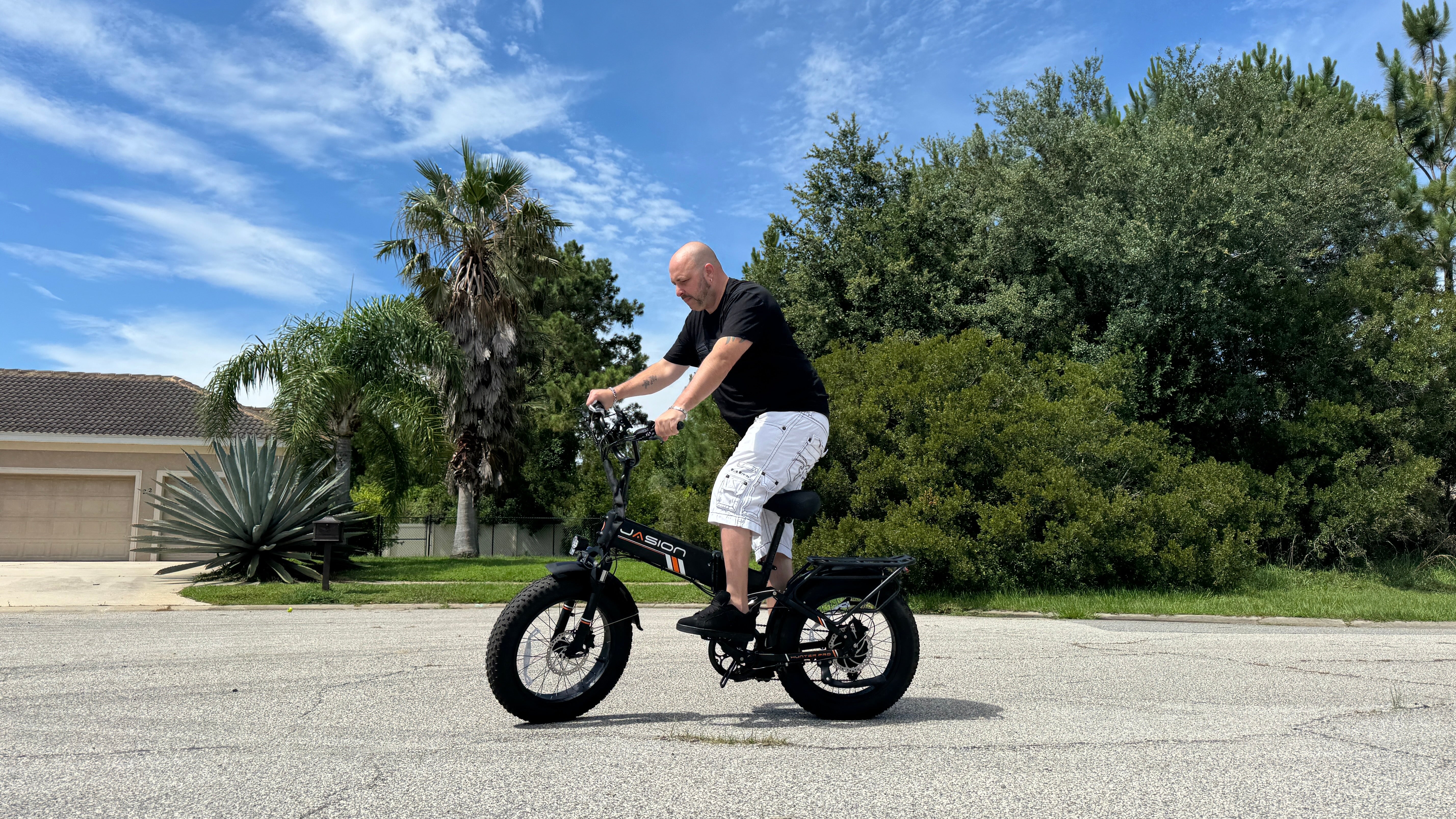
Jasion Hunter Pro: The Upgraded Folding Option
The Jasion Hunter Pro builds on the folding fat-tire format with a larger battery, additional torque, and hydraulic disc brakes.
Current advertised specifications include:
- 1800W peak motor power
- 95 N·m of torque
- 48V 15Ah removable battery
- Up to 80 miles of estimated range under favourable conditions
- 20 × 4-inch fat tires
- Five pedal-assist levels and throttle mode
- Full suspension
- Dual hydraulic disc brakes
- Approximately 82 lb bike weight
The Hunter Pro may be a better fit for riders who prioritize braking control, battery capacity, and additional torque. The trade-off is that it is heavier and requires more effort to lift or move when folded.
Both models advertise performance levels that may exceed the limits applied to standard electric bicycles on some Canadian roads and trails. Check the rules for every intended riding location before use.
Frequently Asked Questions
Are fat-tire e-bikes good in snow and mud?
Wide tires can provide improved flotation and traction on shallow snow, sand, and loose ground. They cannot guarantee control in deep mud, ice, steep terrain, or severe weather. Tire pressure, tread condition, rider skill, and speed all matter.
Are puncture-resistant fat tires puncture-proof?
No. Puncture-resistant tires may reduce the likelihood of damage from small objects, but they can still be punctured or cut. Carry a suitable repair kit, spare tube or patch kit, tire levers, and a portable pump.
Is a folding e-bike easy to carry?
A folding bike is usually easier to store and transport than a full-size non-folding bike. However, folding fat-tire e-bikes commonly weigh more than 70 lb, so they may not be easy for one person to carry for a long distance.
How far can a hunting e-bike travel on one charge?
Actual range depends on the battery, total load, temperature, hills, tire pressure, wind, assist level, throttle use, and riding surface. Treat the manufacturer’s published range as a maximum estimate rather than a guaranteed result.
Can I ride a throttle-equipped e-bike on Canadian trails?
It depends on the specific location. Some Canadian trails permit only lower-powered pedal-assist bicycles and do not allow throttle operation. Check the current rules issued by the park, municipality, province, land manager, or property owner.
Final Thoughts
A folding fat-tire electric bike can help hunters and outdoor riders travel more efficiently, reduce operating noise, transport equipment, and store the bike in a smaller space. Its biggest advantages come from the combination of electric assistance, wide tires, suspension, and a folding frame.
It is equally important to understand the limitations. Fat tires do not make every route safe, advertised range is not guaranteed, folding e-bikes can be heavy, and high-powered or throttle-equipped models are not permitted everywhere.
Choose a bike based on the terrain you actually ride, the equipment you need to carry, your ability to transport the bike, and the regulations that apply to your destination. With realistic planning and responsible use, a folding fat-tire e-bike can become a versatile tool for hunting, camping, and year-round outdoor travel.


Share: